
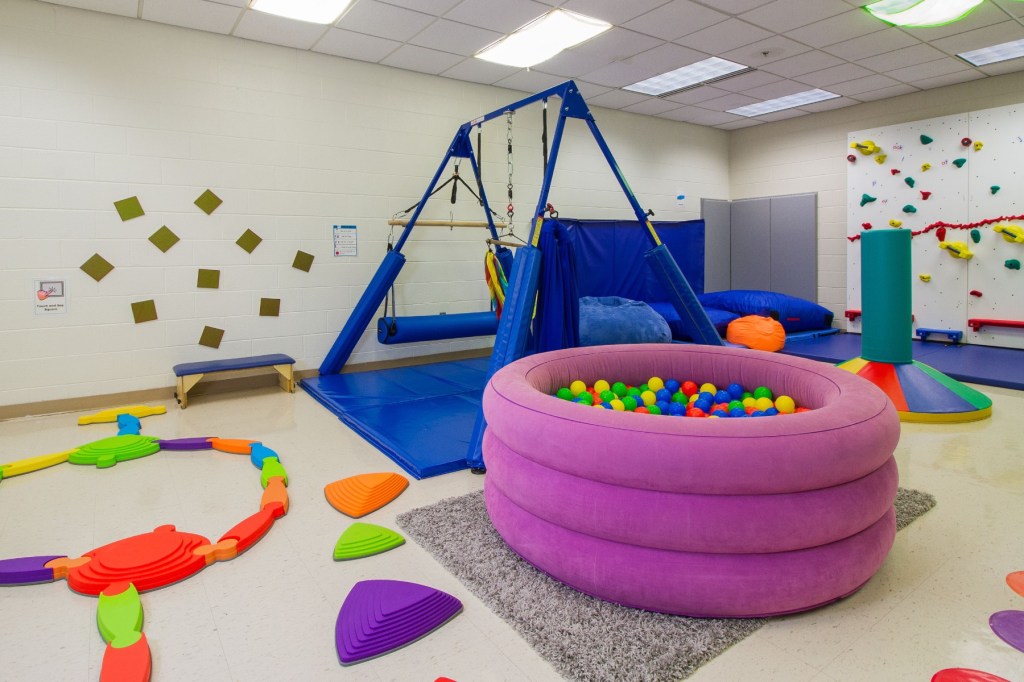
You may have heard the term “sensory room” mentioned but did you know exactly what it meant? As awareness of sensory needs increases, parents, therapists, and institutions are working to create sensory-friendly spaces to make anyone and everyone feel welcome.
What does “sensory-friendly” mean?
“Sensory-friendly” often refers to an environment in which kids are given the sensory input they need to self-regulate and decompress; alternatively, it’s an environment that lacks overstimulating sensory input. This could refer to a classroom, airport, shopping mall, or home environment. It can even refer to specific objects that are made of certain types of fabric or feature less harsh lighting. Since everyone’s needs are different, there is no one-size-fits-all solution.
Learning to recognize triggers in each individual child is crucial to being able to preempt them and avoid sensory overload and a subsequent sensory meltdown. During a meltdown, kids are in fight-or-flight mode. It slowly stops as the triggers are removed and the nervous system can recover. Identifying these triggers enables adults and the child to remove negative stimuli; instead, surround the child with sensory-friendly stimuli specific to his needs for a positive experience.
How do sensory rooms help?
Sensory rooms are focused on providing the best sensory input for specific needs. By using a variety of therapeutic equipment, kids learn to self-regulate their behaviors and ultimately improve their focus. These are typically categorized as “active” or “calming” rooms; sometimes the Fun and Function team creates a hybrid space to serve a wider variety of sensory needs. Often children will start off in an active space and finish in a calming section to bring the sensory experience full circle.
The most important piece of using a sensory room is that it be incorporated into the child’s everyday routine. Spending time in the room should not be held as reward or punishment, rather as part of the overall “sensory diet.” Getting the right mix of necessary sensory input is just as important as eating the proper variety of nutrients to be as healthy as possible.
Some children might not be able to recognize triggers and sensory needs on their own. Parents and teachers can give guidance, in a process known as “co-regulation.” Once the child is able to identify their own needs, they are ready to self-regulate. At this point the sensory room should be available when necessary, instead of forcing its use upon kids.
Types of sensory rooms
Active rooms are great for sensory-seekers, or kids who are under-aroused and crave more stimulation. Movement activities, such as climbing, jumping and swinging, offer proprioceptive and vestibular input. These types of input help to regulate the nervous system and organize the body. Through joint compression, swinging, obstacle courses and climbing activities, kids are able to improve their motor planning skills, awareness of their bodies and help calm their body down so that they are ready to focus and learn.. Ball pits, sensory boards, and therapy trampolines are ever-popular features in active rooms.
Calming rooms are geared towards sensory-avoiders, or kids who are easily over-stimulated and need a break from sensory stimulation. Soothing music and fiber-optic lighting create a relaxing space for decompression. This type of lighting is also known as “autism-friendly lighting,” because kids with ASD often have a concurrent sensory processing disorder that manifests in their visual system. Deep pressure input, such as that from weighted products, causes the muscles to send calming signals to the brain, so that kids can reorganize their thoughts and improve their focus. Rhythmic swinging and motion on a sensory swing is also great for relaxation.
 OCD, Organize Create Design LLC